
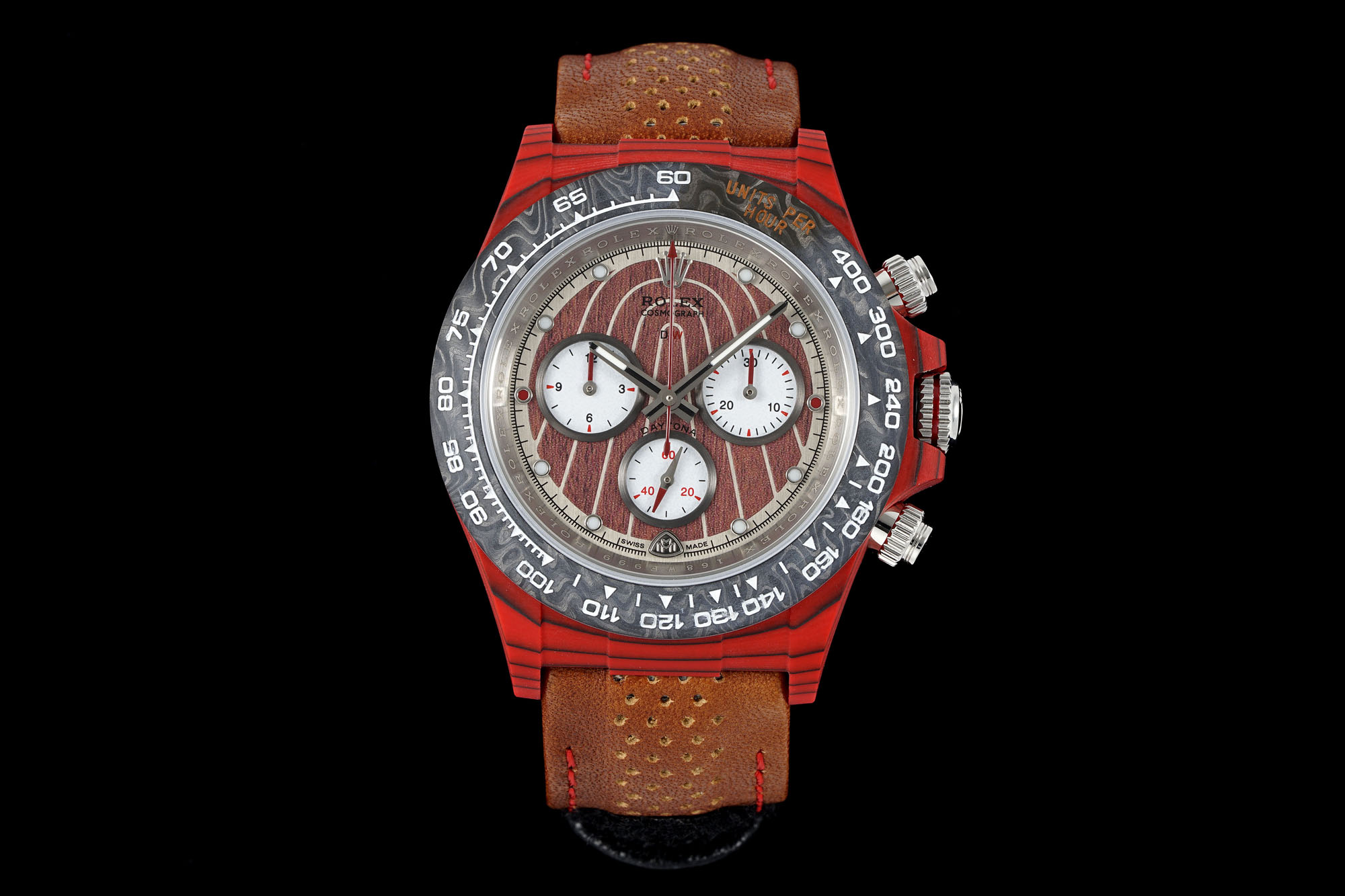
A watchmaker reads a caseback the way an examiner reads a document: method, depth, and placement matter as much as the words. The check covers how the engravings are made, where they sit, and which hallmarks appear — and every finding is compared against what the imitated brand actually does. The 'VS factory' label changes none of this.
The checklist
1. Engraving method
Brands are consistent in how they mark a given model line — some use machine engraving, some stamp, some laser-etch — and the method itself is part of the record. A caseback marked by a method the brand does not use on that model is flagged on sight. The watchmaker distinguishes the techniques by their telltales: stamped characters displace metal and leave an outline, laser work shows fine, even texture, and hand engraving shows irregularity a production line would not.
2. Depth and edge quality
Production engraving is crisp and uniform: consistent depth across every character, clean edges, no wavering baselines. Shallow, uneven, or wobbly text suggests aftermarket work, as does lettering that looks shallow enough to polish off. Under oblique lighting and a loupe, these differences are obvious even to a patient amateur, which is why this check comes early in the examination.
3. Placement and centering
Where the markings sit is documented. On many Omega models, the reference and serial are engraved on the caseback, and their position and orientation are consistent model to model. Rolex sports models, by contrast, have largely smooth, solid casebacks — a Submariner or Daytona with a display back or a busily engraved caseback contradicts the brand's own design, which is the fastest kind of finding. Off-center text, text at an angle, or markings crowded against the edge all suggest the caseback did not leave the brand's production line.
4. Hallmarks on precious metals
Precious metal cases carry assay marks, and their absence is a finding. An 18k gold case should bear the fineness mark 750 and, for Swiss production, the Swiss assay mark — a head of Helvetia; platinum carries a St. Bernard dog's head. Silver carries 925. The watchmaker checks that the marks are present, correctly struck, and not blurred or scratched; a blurred hallmark on an expensive metal case is a classic sign of a marking that was copied rather than struck.
5. Solid back versus exhibition back
Whether the caseback is solid or has a sapphire window is part of the model's design record. Omega Seamaster models are known for exhibition backs that show the movement; Rolex sports models are known for solid steel. The check is simply whether the caseback matches the model it claims to be — a mismatch is decisive and requires no magnification at all.
6. Material marks
Steel cases are identified by their material. Rolex uses 904L steel, which it markets as Oystersteel, while most other brands use 316L — a distinction covered in our case materials comparison. The material itself does not authenticate a watch (904L is commercially available), but the caseback's markings, finish, and material should all agree with the brand's documentation for that model.
What the watchmaker compares against
Every finding is checked against the brand's catalog photography and known genuine examples of the same reference. The point is not to search for a magic mark but to test whether the caseback is consistent with the model it claims to be — the same standard applied throughout our guide to identifying counterfeit watches.
What the hallmarks cannot prove
A correct-looking hallmark proves nothing by itself. Markings are reproducible, and a copied engraving can pass a casual glance. What separates a genuine caseback is the combination: the right method, the right depth, the right position, the right marks, and the right material, all agreeing with each other. The same logic applies to the caseback's text: engraved letters are cheap to produce, which is why the checklist treats every marking as a claim about the brand's standard until the combination of method, depth, position, and material confirms it. Unauthorized copies — under whatever factory name they are sold — tend to get pieces of that combination right while getting the combination wrong, and that is exactly what the checklist is built to catch.
Frequently asked questions
What is the Swiss hallmark for 18k gold?
The head of Helvetia is the Swiss assay mark for 18k (750) gold, and platinum carries a St. Bernard dog's head. Cases are also stamped with the fineness number.
Do replica casebacks carry engravings?
Yes. Engraved text is easy to reproduce, so the presence of markings means little; fidelity to the brand's method, depth, and position is the test.
Is 904L steel proof of Rolex?
No. 904L is a commercially available alloy that Rolex markets as Oystersteel; the material alone cannot authenticate a watch.
Do steel watches carry hallmarks?
No. Precious metal assay marks apply to gold, silver, and platinum; steel cases carry brand and model engravings instead.
This content is for general watch education. It does not verify any individual product or guarantee authenticity, and it is not affiliated with third-party brands or factories.