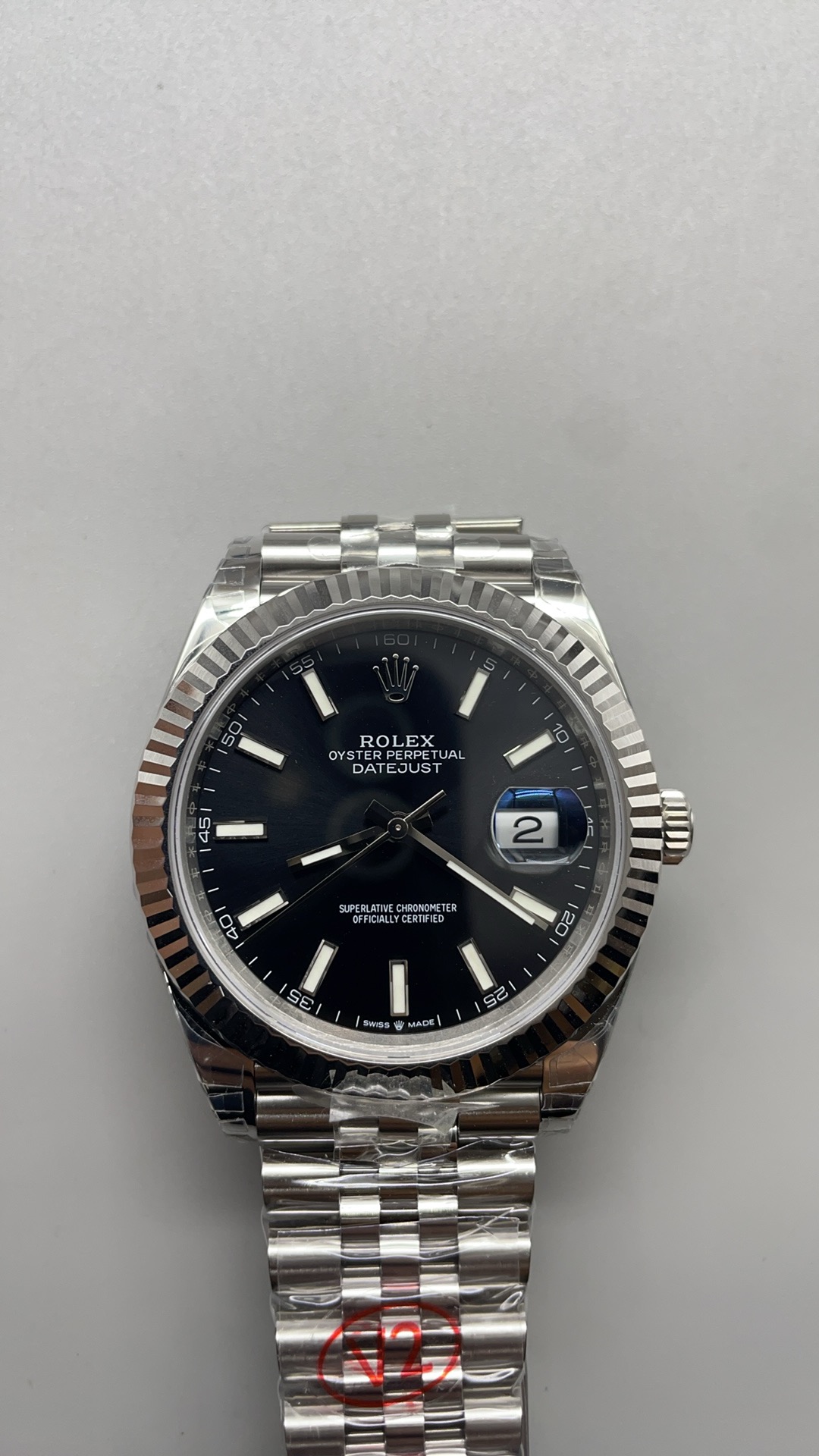
No. Model names, reference numbers, and 'production batch' labels prove nothing by themselves — not for AAA-grade replica watches and not for any other listing. Genuine brands run precise, public reference systems: a Rolex Submariner Date in steel is reference 126610LN. But those numbers are printed in catalogs and repeated across the internet, so any copy can carry the correct code. What matters is whether the name matches the physical watch, not whether the name is right.
How genuine brands actually name models
Rolex uses short references with suffix letters: the previous-generation steel Submariner Date was 116610LN, and the current 41mm version is 126610LN. Omega uses long references from its international database, such as 210.30.42.20.01.001 for the steel Seamaster Diver 300M on a steel bracelet. These codes encode case size, metal, bezel, and dial configuration, and they appear in catalogs, on hang tags, and on warranty papers. Tissot and Cartier work the same way at a smaller scale — Tissot pairs model names with numeric references, and Cartier attaches short references to lines like the Tank and Santos — so every genuine piece carries a name that resolves to one configuration. Because the systems are public and precise, they are also easy to imitate — see the Rolex and Omega brand pages and the Submariner collection for how these names attach to actual models.
Quick answers on naming and authenticity
Does a correct reference number on the case or papers prove anything?
No. Reference numbers are public information, and stamps can be copied — the same logic applies to hang tags, which are printed and copied as easily as any other paper. What matters is whether the dial, case, movement, and papers all agree with the code and with each other — a watch whose parts contradict its reference has a story problem regardless of what is stamped on it.
What is a 'production batch' in forum listings?
Genuine manufacturers manage production internally and do not market watches by batch number. The batch language in replica listings — 'latest batch', 'batch 3 improved bezel' — is a seller label with no public production records behind it. A buyer cannot check which batch a piece came from because no batch exists on paper anywhere.
Do 'V2' and 'V3' version names mark real improvements?
They mark the seller's marketing progression. Whether anything physically changed is unverifiable, and sellers apply version names to the same watch at different prices. The version number is a claim, not a change log.
Why do replica sellers copy model names so carefully?
Because buyers search for the genuine names. Borrowing '126610LN' or 'Seamaster' makes a listing look authoritative and findable, which is precisely why the name itself carries no weight.
What about serial-prefix dating charts?
Rolex used letter-prefix serials until around 2010 and then moved to random serial numbers, so charts can approximate a watch's era but cannot authenticate it. Charts date; they do not verify.
Do enthusiast nicknames like 'Hulk' or 'Pepsi' prove anything?
No. Nicknames such as 'Hulk' for the green Submariner or 'Pepsi' for the red-and-blue GMT bezel are community coinages for genuine models, and sellers copy them freely. A nickname names a look, not an origin.
Where serial numbers fit in
References name the model; serials identify the individual piece. Genuine makers keep serial systems internal, and formats change over time — Rolex's move from letter-prefix serials to random serials around 2010 is the classic example. A listing that offers a 'batch number' is substituting a marketing label for a serial system, which is a substitution worth noticing: real serials are checked against brand records during service, while batch numbers cannot be checked anywhere.
How to cross-check a name properly
- Write down the full reference or model name as the seller gives it.
- Confirm the configuration matches the code: size, metal, bezel, dial color.
- Check that the movement caliber matches the era and model — this usually requires opening the case.
- Verify that papers, hang tags, and engraving repeat the same number exactly.
- When anything is ambiguous, the decision belongs to a watchmaker, not to the listing, and no cross-check completes without the physical piece in hand. Start with how to identify counterfeit watches.
Where batch names end and evidence begins
Batch and version labels are claims in a language no one governs. Evidence is physical: an engraved number made with the right method, a dial that matches its reference, a movement of the right caliber. The factory guides show how factory and batch language is used in practice, and the pattern is always the same — the naming is borrowed, and the proof is absent. A borrowed name is the cheapest part of a listing; the physical watch is the expensive part, which is why the physical watch is where the verification lives.
Frequently asked questions
Do genuine brands name production batches?
Not publicly. Brands manage production internally; watches are identified by reference numbers, serial numbers, and production dates, not by marketable batch labels.
Is 126610LN a real Rolex reference?
Yes — it is the current-generation steel Submariner Date in black, announced in 2020. Because such numbers are public, their presence proves nothing by itself.
Can a reference number be wrong and the watch still be genuine?
Rarely. Genuine watches match their published codes. A mismatch usually means modified parts, a swapped caseback, or a counterfeit.
Do replica V2 or V3 labels correspond to factory revisions?
There is no way to verify that. The version names are seller language with no public records, so treat them as claims, not history.
Why do sellers use genuine model names?
For search visibility and borrowed credibility. The familiar name makes the listing look legitimate even though the name is public and free to use.
This content is for general watch education. It does not verify any individual product or guarantee authenticity, and it is not affiliated with third-party brands or factories.