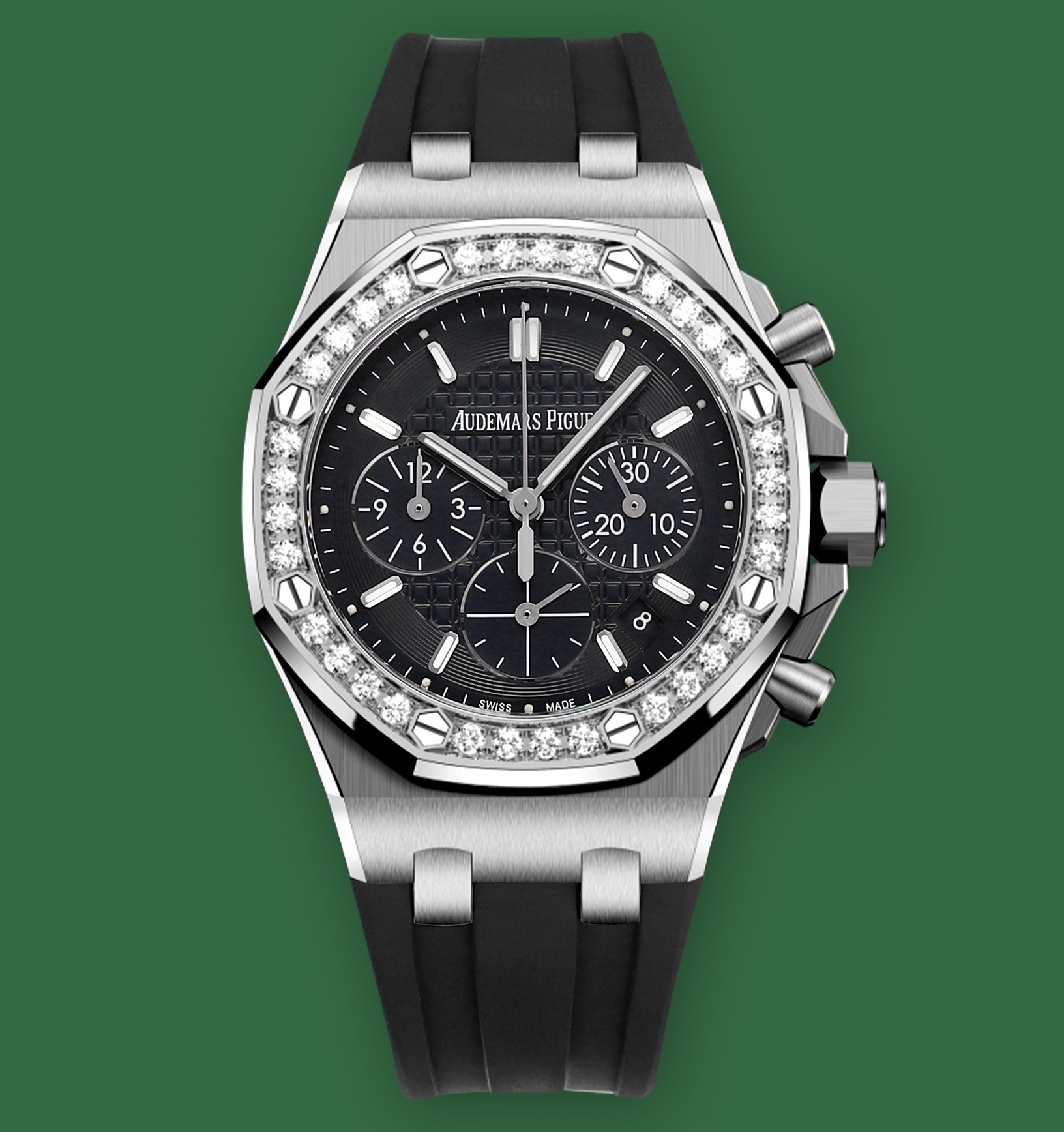
Two different kinds of markings live on casebacks, and listings routinely blur them. Engravings — model text, serials, depth ratings — are plain characters cut into metal, free for anyone with a laser to copy. Hallmarks are legally regulated assay marks for precious metals, backed by statute in Switzerland, the UK, and elsewhere. One is information you should mostly ignore; the other is information worth understanding before you trust it.
Engravings: text on steel
A steel watch's caseback carries whatever the brand decided to engrave: the model reference, the serial, the depth rating, sometimes the metal's commercial name. None of this is legally protected as a marking. There is no registrar for caseback text, and nothing stops a workshop from laser-engraving the same characters onto its own product — which is exactly what happens.
That means claims like “correct caseback engraving” describe copying competence. The engraving may be deep, clean, and well placed, and it still establishes nothing about the watch's origin, exactly as with serial numbers. Our counterfeit identification guide walks through why markings are the weakest link in any authentication attempt.
Hallmarks: legally controlled marks
Hallmarks are a different category, because they are enforced by law rather than by brand practice. In Switzerland, precious-metal articles are assayed and stamped by control offices, and the marks follow defined conventions — for 18k gold, a hallmark alongside the 750 fineness figure, stamped by an officially recognized assay body. The UK operates one of the world's oldest systems, with assay offices stamping fineness and office marks on gold, silver, and platinum articles. In both systems, selling a precious-metal article with a false assay mark is a separate legal offense on top of any trademark issue.
The key contrast: a brand chooses to engrave a caseback, but a hallmark is applied under a legal framework that predates the watch industry's modern brands. A gold Cartier case, for example, carries assay marks alongside the brand's own engravings — and only the assay record is independently checkable. That framework is why a genuine hallmark means something traceable: it can be compared against an assay office's registered punches, while an engraving cannot.
For the materials behind those marks, our case materials comparison covers what 316L, 904L, gold, and other case metals actually are.
Five questions buyers ask about casebacks
1. Does “904L” engraved on a caseback prove the metal?
No. The engraving is text, and text can be placed on anything. Confirming the alloy requires testing — and in practice, 904L versus 316L is not a distinction a buyer can verify visually or by weight, whatever the engraving claims.
2. Is a hallmarked caseback automatically genuine?
No. Counterfeiters stamp fake assay marks too. A stamped mark proves someone stamped it; tracing the mark against the assay office's registered punches and confirming the metal's actual fineness is what gives a hallmark its value, and that work requires the piece and the reference materials.
3. Do dive ratings on casebacks prove water resistance?
No. A depth figure engraved on a caseback is a design claim, not a test result. Real water resistance is established by physical testing under the ISO 22810 standard, and for dive watches under the stricter ISO 6425 standard. Our water resistance explainer details what those standards actually require.
4. Can a buyer check engraving quality from listing photos?
Only at the crudest level. Sharp, evenly lit macro shots can show broken or blobby characters in a careless job, but modern laser engraving photographs perfectly. The fine tooling differences that separate genuine engraving from a good copy need magnification and a comparison sample.
5. What should a listing's caseback claim change about the price?
Nothing by itself. Engraving claims establish copying skill, and hallmark claims require the buyer to do the tracing work. Price the watch on its checkable specifications, not its caseback text. The same logic runs through our coverage of replica watch grading claims.
The usable rule
Keep the two categories separate in your head. Engravings are branding, and copied branding is the entire point of the product category. Hallmarks are legal markings, and their value lives in the assay office's records, not in the stamp itself. When a listing leans on either as proof, ask which record it points to. If the answer is “none,” the marking is scenery.
Frequently asked questions
Are hallmarks only for gold?
No. Assay marks cover precious metals generally — gold, silver, and platinum — with fineness figures such as 750, 925, and 950 appearing alongside the office marks that identify the assaying body.
Can laser engraving reproduce any caseback text?
Yes. Laser engravers reproduce text and simple graphics at fine resolution, so the presence, position, and character count of caseback text prove nothing about origin.
What does the depth rating on a caseback actually mean?
It is the maker's design claim. A watch is only proven water resistant when tested, per ISO 22810 generally and ISO 6425 for dive watches.
Should I pay more for a listing that advertises "correct caseback engraving"?
No. The claim describes engraving competence, which is the baseline for this product category, not a verified quality feature.
This content is for general watch education. It does not verify any individual product or guarantee authenticity, and it is not affiliated with third-party brands or factories.