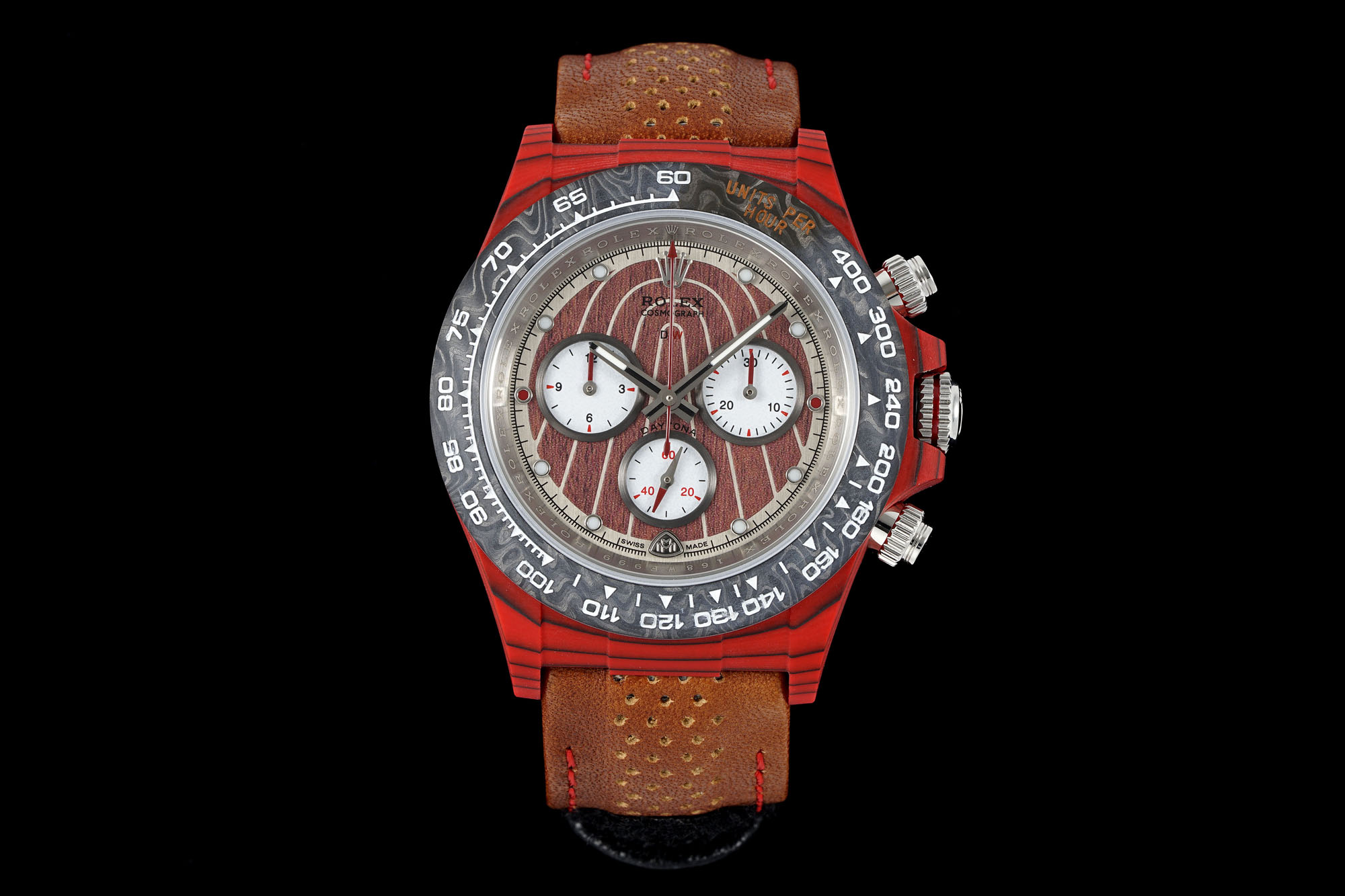
Dial typography and logo positioning get copied and misrepresented in NOOB factory descriptions because they are surface printing, and surface printing is the cheapest detail on a watch to reproduce. The label is forum shorthand with no published dial specification, so every claim about fonts, spacing, or logo placement is a seller's description of a look rather than a measured comparison against an official standard. This glossary translates the terms those listings borrow and explains why each one survives contact with nothing.
The terms sellers borrow
Most of the vocabulary comes straight from how genuine dials are actually made, which is what makes it sound authoritative. Pad printing — tampography — is the standard industrial process for putting text on a dial: a soft silicone pad lifts ink from an etched plate and transfers it to the surface. Applied indexes are separate metal parts, machined, polished, and seated onto the dial rather than printed. Sunburst describes radial brushing that reflects light from the center. Lacquer describes a glossy painted surface. Guilloché describes a repeating engraved pattern, engine-turned on genuine high-end dials and stamped or printed on lesser ones. None of these words is a quality claim by itself; each names a process a copy workshop can imitate in whole or in part.
Why the printing itself is easy to copy
Pad printing is everywhere. The same tampography machinery and technique that prints a genuine dial's minute track prints the text on an unauthorized copy, which is why crisp lettering proves nothing: it proves a printer did its job. Genuine dials are held to tight tolerances on ink edges, line thickness, and registration between passes, checked under magnification at the factory. Copies vary from batch to batch, and at listing resolution both can look identical. A seller can therefore write 'perfect print, correct fonts, factory-aligned coronet' without any of it being measurable from the photos, and without anything official to measure it against, because the label has no spec sheet of any kind. The naming landscape around the label is mapped in the factory terminology guide.
What logo-position claims really describe
Logo placement claims trade on fractions of a millimeter. On a genuine Submariner dial, the coronet sits in a fixed relationship to the text stack and the applied markers, and collectors know the look of that layout. A listing that says 'logo position matches the original' is asserting the seller has done that comparison; nothing in the listing demonstrates it, because sub-millimeter differences do not survive compression, viewing angle, and seller lighting. The same limit applies to claims about the text stack itself — 'OYSTER PERPETUAL DATE' over 'SUBMARINER' over the depth rating — which any printer can reproduce line for line. The genuine layout is there to study on the Rolex Submariner collection.
Misrepresentation is the point, not the accident
Some misrepresentation is deliberate. The 'Swiss Made' text has legal requirements in Swiss law, and the specific thresholds have been revised over time; the words themselves can be printed by anyone, so their presence on an unauthorized piece means nothing about where it was made. Descriptions then build on the borrowed text: a listing that says 'Swiss-grade lume' or 'factory-correct dial' stacks two unverifiable claims onto one printed fact. A claim stated confidently is still a claim, and under a forum label with no official standing there is no channel to dispute it, which is exactly why the language is free to use. How to read grading language of this kind is covered in replica watch grading claims.
The five terms you will actually see
- 1:1 dial print — forum shorthand meaning 'matched to the original design,' a claim with no test behind it.
- Perfect coronet — the brand emblem; claims about its placement and detail that photos cannot resolve.
- Correct fonts — typeface fidelity; the real differences are sub-millimeter and invisible at listing resolution.
- Swiss-grade lume — a luminous-material claim; brightness and longevity are measured over time, not in a photo.
- Factory-aligned — a claim about assembly precision that no seller of unauthorized goods is in a position to certify.
What to do with the vocabulary
Treat every typography claim as a description of intent, not a property of the watch. The checks that matter — raking light, magnification, and a side-by-side against the genuine reference — require the watch in hand, which is exactly why listings lean on words instead. For a systematic method that does not depend on trusting the description, start with how counterfeit watches are identified.
Frequently asked questions
What does 'NOOB factory' actually mean?
It is forum shorthand for a workshop known in replica communities for Rolex-style pieces, especially Submariner-style watches. It is not a registered company and publishes no specifications, so any detail attached to the name exists only in seller listings.
Can misaligned dial text in a photo identify a copy?
Not reliably. Gross errors can be caught at listing resolution, but fine alignment differences do not survive photography, and genuine dials carry their own small variances, so a photo cannot settle the question either way.
Do genuine brands print dial text with pad printing?
Yes. Tampography is the industry-standard process for dial text, which is exactly why the printing method itself proves nothing about a watch's origin.
Why do listings stress logo placement so often?
Because it sounds technical and it is one of the few claims a buyer cannot check from photos. Sub-millimeter placement differences are invisible at listing resolution, so the claim costs nothing to make.
Is the 'Swiss Made' text on a dial meaningful?
On a genuine watch it indicates compliance with the Swiss legal requirements for the label. The words themselves can be printed by anyone, so on an unauthorized piece they carry no meaning about origin.
This content is for general watch education. It does not verify any individual product or guarantee authenticity, and it is not affiliated with third-party brands or factories.