
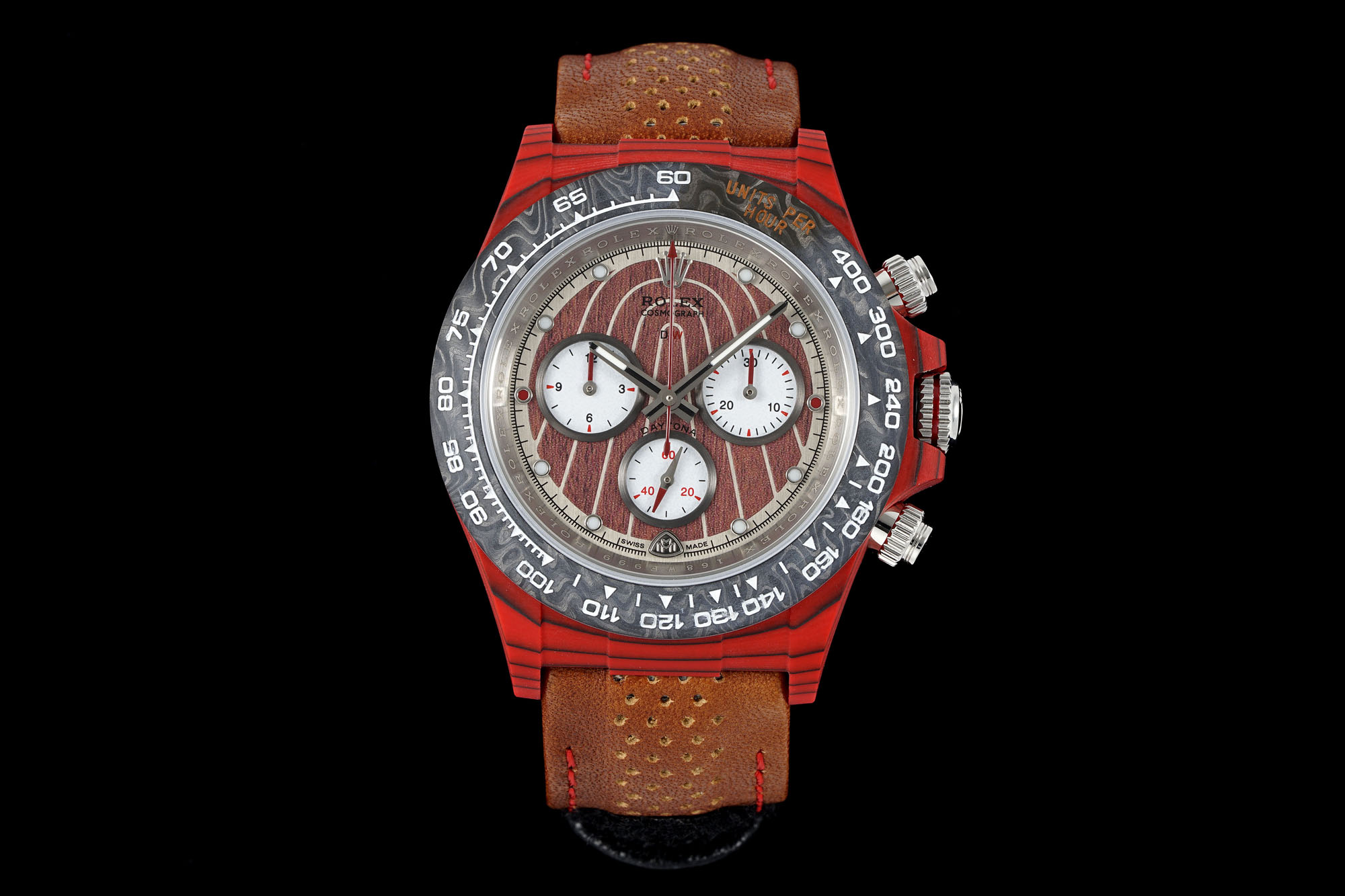
Most phrases in a NOOB-labeled listing are seller marketing with no independent meaning. Swiss movement, 1:1, AAA grade, and QC photos all sound technical, but in the replica market none of them is defined by anyone except the seller, and none is verified by a third party before you pay. Reading a listing is less about decoding terms than about recognizing which ones were never decodable.
A typical listing, line by line
Here is how the recurring claims break down when read carefully. The example below is a composite of the standard phrases; the point is the reading method, not any particular listing.
Swiss movement
In this market, Swiss movement almost always describes a clone of a Swiss design assembled outside Switzerland. Swiss law defines when a movement can be marked Swiss, and a listing that says Swiss movement rather than naming the movement is usually avoiding that definition. A seller who cannot name the calibre, or show it, is describing an idea, not a component. For what the words mean on a genuine watch, the movement explainer starts from the basics.
1:1 best edition
There is no grading body in the replica market, and no standard that defines what 1:1 requires. The phrase is a comparison claim, same as the genuine article, that no one is in a position to certify, because the genuine article's specifications are not published for copyists to match. Different sellers use the same words for different levels of work. The full tour of such labels lives in the guide to grading claims.
AAA+++ grade
Pure marketing. Grades in this market stack letters and plus signs without meaning, and the same watch can be listed at AAA+ in one store and AAAAA in another. There is no tier system, no inspection behind the tier, and no consequence for the seller when the tier disappoints.
Sapphire crystal
A claim that is actually testable, in hand. A watchmaker's thermal tester distinguishes sapphire from mineral glass in seconds, and mineral glass is common at the lower end of the price scale. The listing text cannot be checked from the listing page, which is exactly why sellers write it.
QC photos before shipping
The most useful phrase in the standard set, within strict limits. Pre-shipment photos can reveal dust under the crystal, misaligned markers, or a scratched clasp, and buyers do catch problems this way. What the photos cannot show is the movement's health, the crystal's material, the case's plating, or the state of the seals. QC photos document appearance, and appearance is the one thing this market polishes hardest.
Same factory as the original
Meaningless. Genuine watch brands do not share production with unauthorized factories, so no watch labeled NOOB comes from the same line as the watch it copies. The phrase is an attempt to borrow authenticity by association, and it borrows nothing.
Original box and papers
Accessories can be copied as easily as watches. A copied box is a box, and a copied warranty card is a piece of paper. It is not the brand's service record, and it activates no warranty. Accessories in a listing photograph do not authenticate anything in the box.
Waterproof 30m
Two problems in two words. First, the claim is unverified until a pressure test says otherwise. Second, even on a genuine watch, 30 meters does not mean the watch survives 30 meters of swimming. In standard terminology it means resistance to splashes, as the water resistance explainer details. A NOOB-labeled watch with 30m in the listing is a dry watch until tested.
Red flags beyond the wording
The claims matter less than the patterns around them:
- Photos of a genuine watch borrowed from elsewhere, especially studio shots that no seller could have taken.
- A price far below the apparent going rate for the same described watch.
- Refusal to photograph the movement, the case side, or a specific angle when asked.
- Pressure to complete the transaction outside the platform's payment system.
- An account that lists many rare watches, all new, all with the same background.
Each of these has an innocent explanation individually. Together they describe a seller optimizing for the sale rather than the description, which is the pattern that matters. More of the in-hand checks behind these heuristics are in the counterfeit identification guide.
What a claim can and cannot do
A listing claim can set expectations; it cannot change what ships. The practical test splits claims into two piles. The first pile is verifiable in hand: crystal material, timing on a timegrapher, water resistance on a tester. Those get checked at the first inspection. The second pile is everything else: grade labels, factory names, movement adjectives, and comparison language. Those are not checked at all, because there is nothing to check them against. Buying on the second pile is buying the seller's confidence, not the watch.
Frequently asked questions
What does a V2 or V3 version label mean?
It is a seller's revision label for its own listings. There is no shared standard across sellers, so a V3 at one store has no relationship to a V3 at another.
Are all listing claims false?
Not all, and that is the trap. Some watches match their descriptions, but nothing on the listing page lets you know which ones before delivery. The honest posture is unverified until checked in hand.
Does a timegrapher photo prove the movement is healthy?
It shows one reading in one position at one moment. Healthy movements are evaluated across several positions, so a single photo supports the listing without proving much.
Can I recover money if the claims turn out false?
Recovery depends on the seller's willingness and the payment method's protections. There is no consumer-protection framework built around unauthorized copies, so treat the purchase price as at risk.
本コンテンツは一般的な時計教育を目的としています。個別の製品を検証したり真贋を保証したりするものではなく、第三者のブランドや工場とは一切関係ありません。