
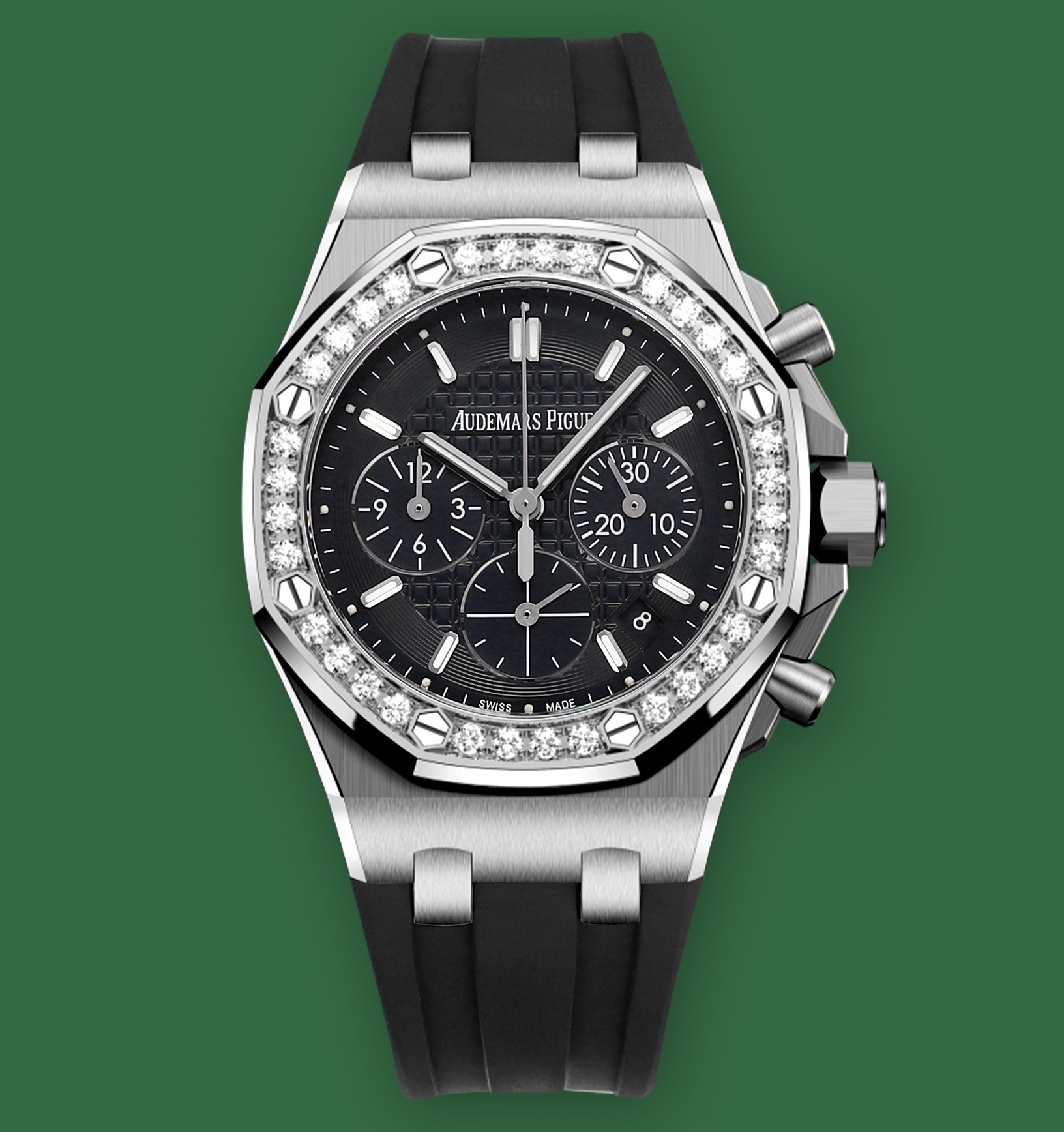
The specifications that matter when a “AAA-grade replica watches” listing is compared with a genuine Royal Oak are the published specifications of the genuine references: case diameter, case thickness, bezel geometry, bracelet construction, and the finishing details you can see without opening the case. There is no official specification for a AAA-grade replica, because the grade is seller terminology with no certifying body behind it. The practical approach is to hold the listing’s claims against Audemars Piguet’s published reference data and see where they fall apart.
What an integrated bracelet is on the Royal Oak
The Royal Oak’s defining trait is that its bracelet grows out of the case without conventional lugs. Gerald Genta’s 1972 design made case and bracelet one continuous metal form: the first links complete the caseband, and the bracelet tapers steadily toward the clasp. The octagonal bezel, its eight visible hexagonal screw heads, and the textured “Grande Tapisserie” dial are part of the same design language. Because the bracelet is structural, a watch that imitates the case but bolts on a generic bracelet breaks the silhouette immediately — one of the easiest discrepancies to spot in a photo. The 39 mm original earned the nickname “Jumbo” because it was oversized by 1972 standards, and that history is why the extra-thin 39 mm and the 41 mm Selfwinding both matter when a seller quotes a diameter.
Official specifications that define the design
Audemars Piguet publishes the key dimensions for each reference, and two references attract most of the comparisons:
| Specification | Royal Oak “Jumbo” 16202ST | Royal Oak Selfwinding 15510ST |
|---|---|---|
| Case diameter | 39 mm | 41 mm |
| Case thickness | 8.1 mm | 10.5 mm |
| Water resistance | 50 m | 50 m |
| Movement | Calibre 7121, automatic | Calibre 4302, automatic |
| Bezel | Octagonal, 8 hexagonal screws | Octagonal, 8 hexagonal screws |
| Bracelet | Integrated steel, folding clasp | Integrated steel, folding clasp |
These are catalog specifications, not secret measurements. Any watch presented as a copy of either reference can be checked against them with a caliper and a loupe — and thickness is the number replica listings most often leave out, because it is the number that usually fails first. The collection also includes smaller Selfwinding models and chronographs, but the two references above cover most comparisons because they are the ones replica listings name most often. The point of the table is not to memorize numbers; it is to notice which numbers the seller omits.
What “AAA-grade” claims in a listing
AAA-grade is forum shorthand that sellers apply to their own stock. It has no official definition, no issuer, and no inspection standard, and two sellers can use the label for visibly different watches. The replica grading claims guide walks through why tier labels should be read as marketing rather than measurement. For a Royal Oak-style watch, the relevant test is not the grade in the title but whether the physical watch matches the reference data above.
Details that are hard to fake, easy to check
- Bezel screws: on a genuine Royal Oak the visible heads stay aligned with the octagon because the screws are set from the caseback side. Copies frequently show heads sitting at random angles.
- Bracelet taper and links: the genuine bracelet tapers smoothly, and the link edges are sharply finished. Pressed or cast links with soft edges read clearly in macro photos.
- Case thickness: a caliper reading is decisive. Many copies of the 41 mm model run thicker than 10.5 mm because a generic movement needs more room.
- Dial texture: the machine-turned tapisserie pattern is crisp on the genuine dial; printed or shallow-etched imitations flatten in close-up photos.
- Clasp and engraving: the genuine folding clasp closes with a distinct two-step action and carries crisp engraving; copies often use a lighter stamped clasp.
Why the bracelet matters beyond looks
An integrated bracelet is not a strap you can swap in a minute. Sizing means removing links, and the links on a copy are often held by soft screws that strip on the first adjustment. Wearability is also a specification question: strap choice changes how a watch fits, which matters more on a fixed-lug design than anywhere else. If the case wears too large or too small on your wrist, a strap swap is not the escape hatch it would be on a standard-lug watch, so sizing against the case size guide belongs before the purchase, not after.
The honest limits of a spec-sheet comparison
Dimensions only go so far. The movement, its finishing, and the feel of the clasp cannot be verified from numbers, and a copy can match diameter and thickness while failing everywhere else. A caliper answers size questions in seconds, but it cannot feel a balance wheel or examine a movement, which is why the checklist below ends with claims discipline rather than measurements. A physical comparison matters more than a listing photo, and that is why the counterfeit identification guide puts movement views and hands-on checks first.
A five-point comparison checklist
- Ask the seller which reference the watch is modeled on. No reference number means no specification sheet to compare against.
- Check diameter and thickness against the published specs above.
- Study bezel screw alignment and bracelet taper in macro photos.
- Ask for a movement photo through the caseback and compare it with the genuine caliber.
- Treat any “genuine-grade materials” wording as a claim, not a fact.
Frequently asked questions
Is “AAA-grade” something that appears on the watch itself?
No. The grade lives in listings and forum posts. A genuine Royal Oak is identified by its reference number and its case and serial numbers — a grade label on a listing is the seller’s marketing, and no such label exists on the watch.
Why do replica listings so often omit case thickness?
Thickness is the specification that copies fail most often, because a generic automatic movement needs more height than the genuine caliber. A listing that gives a diameter but no thickness is leaving out the number that usually fails first.
Can dimensions be judged from photos alone?
Not measured, but proportions can be read. A copy of the 41 mm reference whose dial-to-case ratio or bracelet proportions look off in photos will not match the real thing even before a caliper comes out; the caliper then confirms it.
Do genuine Royal Oak bracelets fit non-genuine cases, or the reverse?
Not reliably. Integrated bracelets are case-specific, and no maker publishes interchangeability data between genuine and non-genuine parts. Any listing claiming such a mix fits is making an untestable claim.
Questo contenuto è a scopo di educazione orologiera generale. Non verifica alcun singolo prodotto né garantisce l'autenticità, e non è affiliato a marchi o fabbriche di terzi.
