
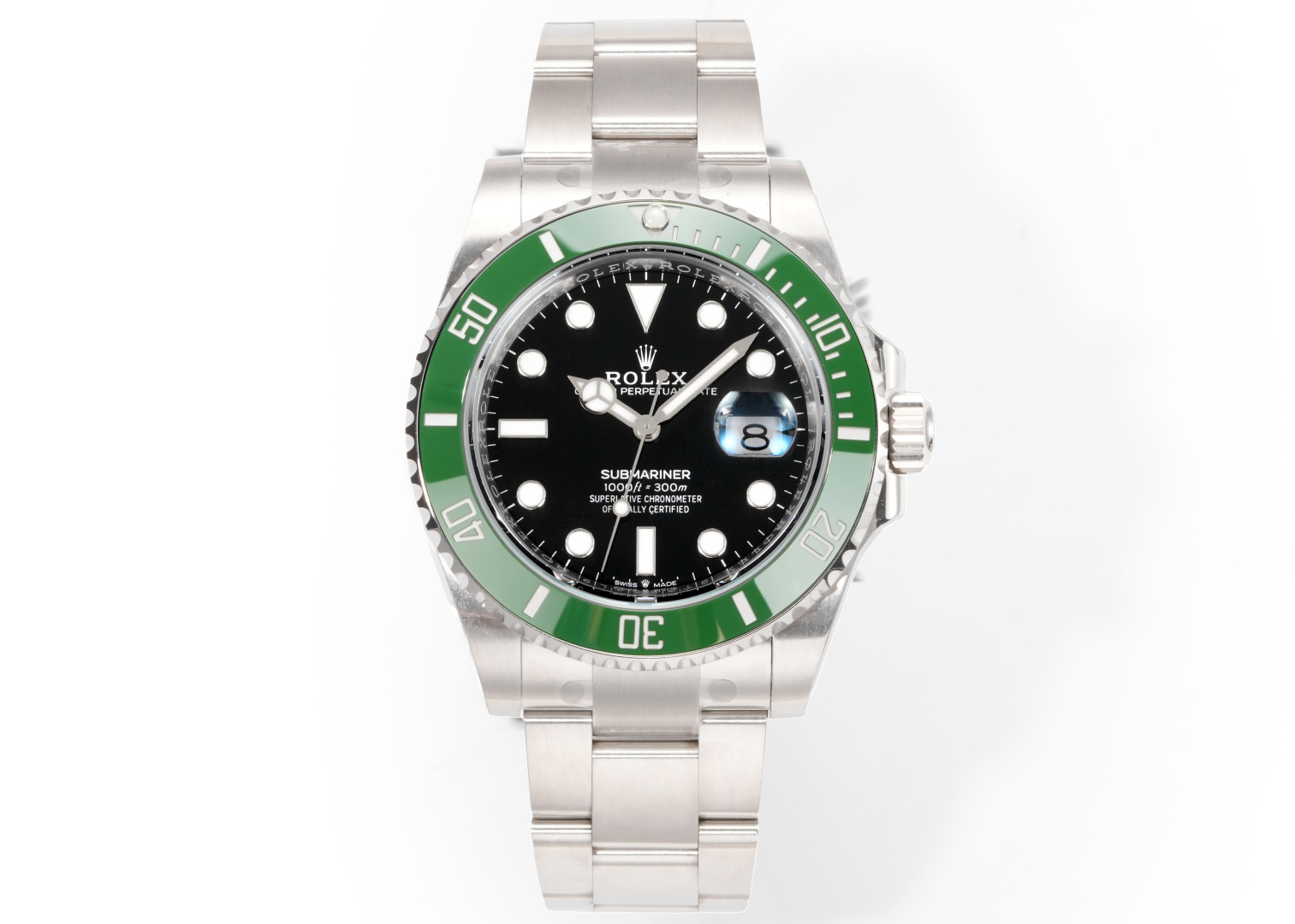
The serial and reference checks that matter on a suspected NOOB-style watch come down to five: does the serial match the brand's format and location, does the reference number match the watch's configuration, is the engraving quality plausible, is the caseback consistent with the model, and do the documents' serials match the watch. None of these checks is conclusive on its own; several agreeing is what matters, and the reliable confirmation always happens off your desk, not on it.
This walkthrough takes each check in turn, with the Rolex Submariner as reference.
Check one: serial number format and location
Every brand has a serial number system, and where the serial sits is itself a check. On modern Rolex models, the serial is laser-engraved on the rehaut — the inner bezel ring — at the six o'clock position; on older Rolex watches it was engraved between the lugs. An Omega serial typically sits on the caseback or a lug. A suspected counterfeit commonly trips on these details: the serial sits in the wrong place, uses a format the brand never used, or looks stamped rather than engraved.
A second, harder-to-spot signal is repetition. Counterfeit operations assign serials in batches, so the same serial can appear across many watches sold by different sellers. If a specific serial turns up on multiple unrelated listings, that is a strong warning sign — genuine serials are unique per watch. Our NOOB factory page explains why these watches carry markings at all: the markings exist to imitate, not to identify.
Check two: reference and model markings
Rolex engraves the reference number between the lugs at the twelve o'clock position, and the reference must match the watch's configuration. A Submariner Date with a date window should carry the date reference; a no-date Submariner carries the no-date reference. Counterfeit assemblers mix parts across generations, so mismatches are common: a dial and case that do not agree with the reference number, or a reference number that matches one model while the bezel and bracelet belong to another. Cross-checking the reference against the genuine model's known configuration — documented on our Rolex pages — catches a large share of counterfeits before any deeper inspection begins.
Check three: engraving and dial printing quality
Genuine Rolex rehaut engraving is laser-cut, sharp, and evenly spaced, and the crown logo at twelve o'clock on the rehaut aligns with the dial. On counterfeits, the commonly cited differences are soft edges, uneven letter spacing, misaligned text, and shallow depth. The same applies to dial printing: genuine printing is crisp under magnification, while counterfeit dials often show ink spread or uneven letterforms. These differences are judgment calls rather than hard tests, which is why they work best in combination with the other checks — and why our counterfeit identification guide treats magnification as one tool among several.
Check four: the caseback
Most modern steel Rolex models have plain casebacks with no engraving; the Sea-Dweller Deepsea's titanium caseback with engraved text is a known exception rather than the rule. A modern Submariner-style watch with an exhibition window, decorative engraving, or a deeply stamped logo on the back is therefore a red flag. Counterfeit watches often add decoration where the genuine watch has none, on the theory that buyers expect engravings everywhere. Knowing what the genuine model actually looks like — plain, in this case — is the check itself.
Check five: documents against the watch
Genuine papers do not just exist; they match. The serial on a warranty card or receipt must agree with the serial on the case, and the reference on the documents must agree with the reference between the lugs. Mismatched serials, a reference that belongs to a different model, or paperwork with misspelled brand text are classic signs that the watch and the story were assembled separately. Counterfeiters produce convincing boxes and cards, so convincing-looking documents are not reassurance — agreement between the documents and the watch is the minimum, not the proof.
The limits of do-it-yourself checking
Every check above is a screening tool, and high-quality counterfeits pass casual versions of all five. That is the honest limit: serial placement, reference matching, engraving, casebacks, and paperwork checks filter out the rough majority, but they do not certify. The reliable verification routes are the ones with consequences — a brand service center, an authorized dealer, or a qualified watchmaker who opens the case and inspects the movement. If the watch matters, the inspection should happen there rather than in a listing's photographs. Our catalog and FAQ point to the sources that can actually vouch for a watch.
Frequently asked questions
Do counterfeit watches have serial numbers?
Yes, commonly. Counterfeiters add serials because buyers expect them, so the presence of a serial proves nothing by itself.
Where is the serial on a modern Rolex?
Laser-engraved on the rehaut at the six o'clock position. Older Rolex watches carried the serial between the lugs.
What if the papers' serial does not match the case?
That is a classic red flag. Genuine documents agree with the watch on serial and reference; a mismatch means the watch and the story were assembled separately.
Are Rolex casebacks engraved?
Most modern steel Rolex models have plain casebacks. The Sea-Dweller Deepsea's engraved titanium caseback is a known exception, not the rule.
Can I check a serial against Rolex's records myself?
Rolex does not offer a public serial lookup. Verification runs through a service center or an authorized dealer, which is also where a definitive authenticity check happens.
Ce contenu est destiné à l'éducation horlogère générale. Il ne vérifie aucun produit individuel, ne garantit pas l'authenticité et n'est affilié à aucune marque ou usine tierce.