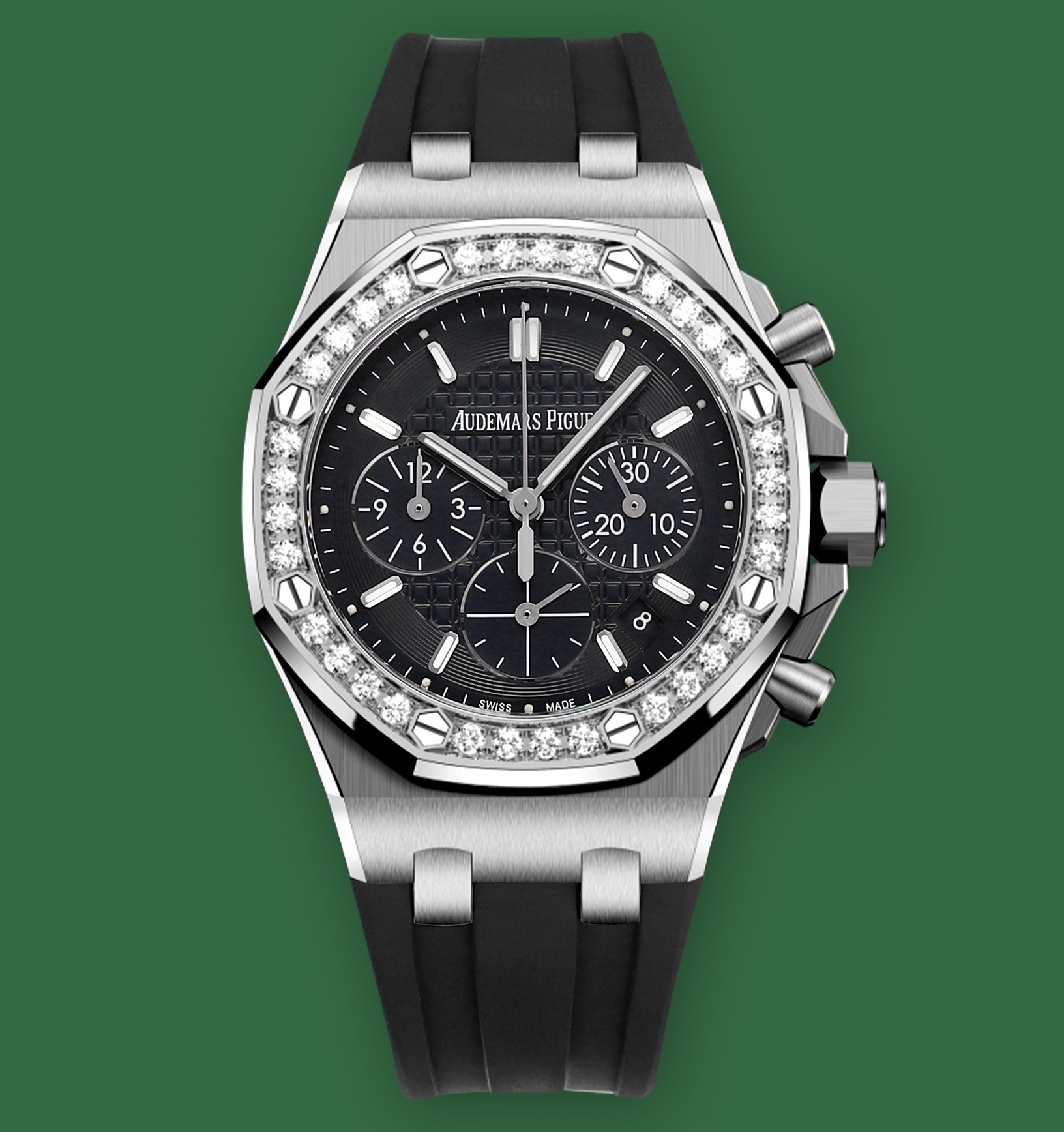
Material claims on AAA-grade replica watches listings do not reliably indicate manufacturing quality, because none of them can be verified from a photograph and some barely matter in daily wear. Terms like 904L steel, sapphire crystal and ceramic bezel describe real materials with real differences, but a seller's word is not a test report. Each claim deserves its own look at what the term actually means.
The case: 904L versus 316L
904L and 316L are both austenitic stainless steels. 904L carries more nickel, chromium and molybdenum, which gives it better corrosion resistance, and it is the steel family Rolex uses and calls Oystersteel. 316L is the standard watch industry alloy, used by the majority of brands including Omega for many models. The two look essentially identical, and distinguishing them requires laboratory testing, not eyesight. A case stamped or described as 904L therefore tells you nothing you can confirm, and for ordinary wear the practical difference is negligible. The stamping question is the same as with the crystal: the claim is untestable by the buyer, and the only difference that survives is corrosion behavior over years of exposure, which no listing will ever be asked to answer for. Our case materials comparison covers the trade-offs in more detail.
The crystal: sapphire versus mineral
Sapphire crystal is synthetic corundum, a 9 on the Mohs hardness scale, which makes it highly scratch-resistant but also brittle enough to chip or shatter on a hard impact. Mineral glass is cheaper, scratches more easily and is common on entry-level watches. The difference is real, but identifying which is fitted is harder than the listing suggests: home tests are unreliable, and a proper check means testing by someone who works with watch crystals. Under a loupe, sapphire sometimes shows a faint blue-white sheen at the edge, though this is a weak cue and no substitute for professional testing. On an unauthorized watch, the word sapphire in a description is exactly that: a word.
The bezel: ceramic versus aluminum
Ceramic bezel inserts are fired, polished and virtually scratch-proof, though they can crack under sharp impact; aluminum inserts scratch and fade, which some collectors value as a period look. Both are legitimate industry materials, and a ceramic bezel is now standard on genuine dive watches like the modern Submariner. On genuine modern dive watches the insert sits flush or fractionally below the bezel rim and the luminous pearl is embedded in the ceramic; on cheap copies the pearl is often a dot of paint on a printed insert. The claim on a copy is unverifiable until you handle the watch, and even then a poorly made ceramic insert and a well-finished aluminum one can be confused at a distance.
Plating and gold claims
Claims of 18k gold, solid gold or thick plating sit on the same weak ground. Genuine precious-metal content is confirmed by assay, and plating thickness is measured in microns with equipment no buyer brings to a listing. Most gold claims on replica listings describe plating or wrapping of unspecified thickness, which is why the description is not worth more than the return policy attached to it.
What you can observe instead
Some material differences announce themselves to the senses, and they are the closest thing to verification a buyer gets before purchase. Steel cases feel heavier than alloy imitations at the same dimensions; a ceramic insert sounds and feels harder than a coated plastic one when tapped; plating wears at edges and lugs where friction is constant. None of these observations proves a material, but they are real checks, and they are why hands-on comparison beats any listing text.
Genuine brands communicate materials differently. An official spec sheet lists what the watch is made of, and the brand is accountable for that list under consumer-protection law where it sells. An unauthorized seller's description is accountable to nothing, which is the practical gap between a spec and a claim.
Why none of it can be checked before buying
Every one of these claims shares the same failure: verification requires the physical watch and, in several cases, laboratory equipment, while the sale requires only a photo and a payment. Grading language like AAA sits on top of the same structure, which our page on replica watch grading claims unpacks. The honest position is to assume unverified until tested, and to compare materials only where they change how you use the watch. If the bracelet matters as much as the case to you, our strap and bracelet comparison applies the same logic to what holds the watch on your wrist.
Frequently asked questions
What is 904L steel?
A corrosion-resistant austenitic stainless alloy used by Rolex. It looks identical to 316L, and only laboratory testing can tell them apart.
Is sapphire crystal truly scratch-proof?
Nearly: it rates 9 on the Mohs scale, so everyday materials will not scratch it, but it can still chip or shatter on hard impact.
How can I test a crystal at home?
Home tests are unreliable. A watchmaker or jeweler with the right equipment can confirm whether a crystal is sapphire.
Which bezel material lasts longer?
Ceramic resists scratches far better than aluminum, while aluminum tolerates impacts without cracking and fades over time.
Can 18k gold claims be trusted on replicas?
Only an assay confirms solid precious metal. Most gold claims on unauthorized watches describe plating, whose thickness is never stated or verified.
Dieser Inhalt dient der allgemeinen Uhrenbildung. Er verifiziert kein einzelnes Produkt und garantiert keine Echtheit; zudem besteht keine Verbindung zu Drittmarken oder -fabriken.