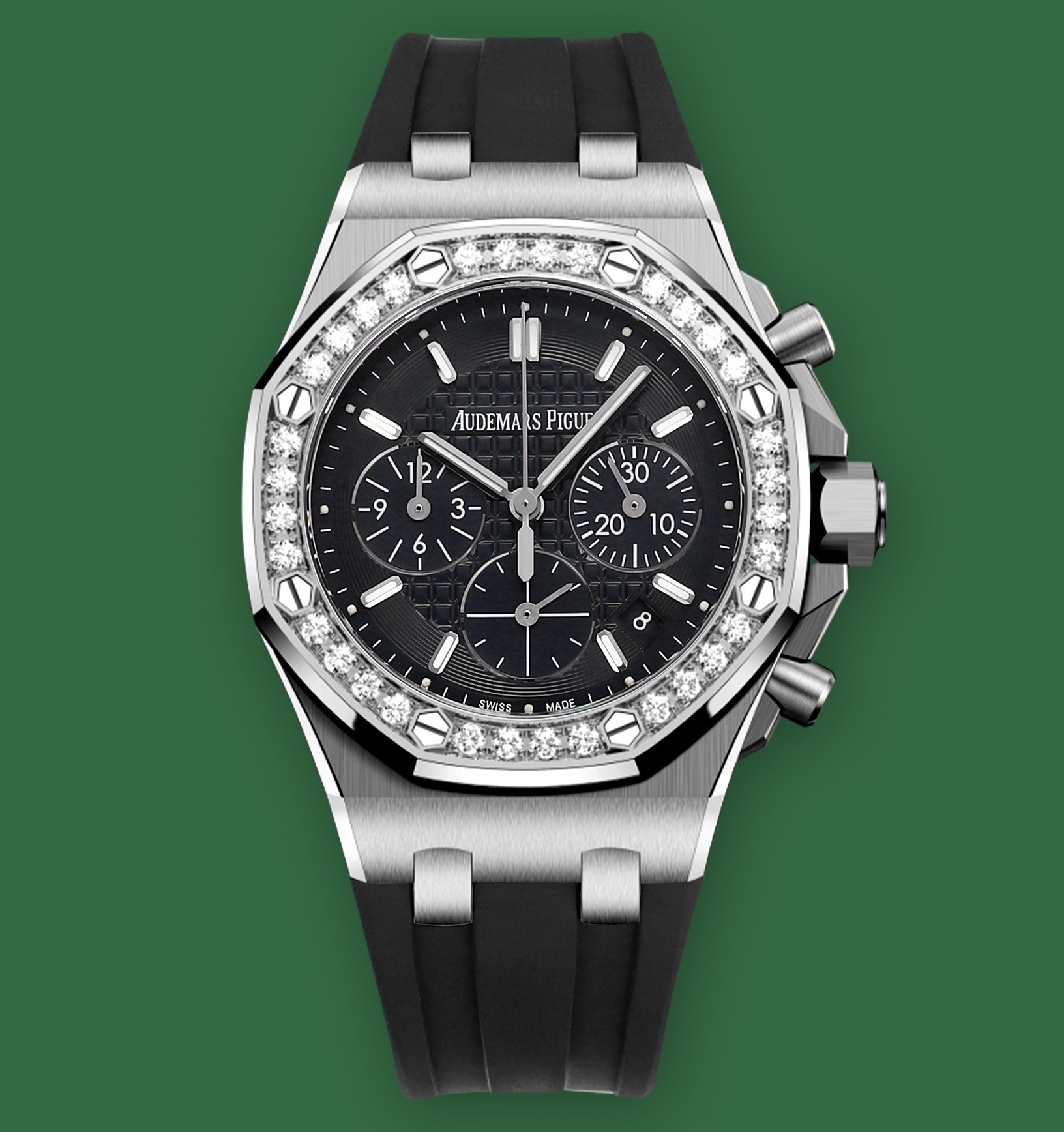
Forum threads discussing the VS factory label mention Audemars Piguet references such as the Royal Oak 15202, the 41 mm 15500, and Offshore chronographs. Those reference numbers are real: AP uses them to identify models, and each describes a specific case size, complication set, and dial type. That specificity is the useful part — it gives you concrete details to compare. The VS factory attribution itself is unofficial forum shorthand with nothing verifiable behind it.
What a reference number does
Brands use reference numbers as internal model identifiers, and they change as models evolve. The Royal Oak line has moved through several generations of four- and five-digit references, which is why threads mention several at once. The current 41 mm chronograph generation succeeded earlier 41 mm chronograph references, and the Jumbo's 15202 moved to 16202 with an updated movement — reference changes track real changes in the product, which is why a listing citing several numbers at once is usually quoting generations, not alternatives. The numbers are public catalog information; anyone can look up what they denote, and that is precisely how to use them. For the line's context, see the Audemars Piguet collection guide.
References you'll see, and what they describe
| Reference | What it denotes | Visual details to check |
|---|---|---|
| 15202 / 16202 ("Jumbo") | The 39 mm Royal Oak, time-and-date only, notably thin | Overall thinness, octagonal bezel with eight hexagonal screws, date window framing |
| 15450 / 15550 | The 37 mm Royal Oak | Smaller proportions on the same tapisserie dial and screw bezel |
| 15400 / 15500 / 15510 | Successive 41 mm Royal Oak generations, date only | Dial text "Audemars Piguet," tapisserie pattern depth, case thickness, bracelet integration |
| 26240 | The current-generation Royal Oak chronograph | Three subdials, pusher function, subdial spacing, flange details |
| 26470 | The 42 mm Royal Oak Offshore chronograph | Beefier case and crown guards, chronograph function, strap or bracelet fit |
The three details that reveal workmanship
First, the bezel screws: on genuine Royal Oaks the hexagonal screw heads sit in the same orientation, aligned with the bezel's geometry. Second, the tapisserie: the stamped guilloché pattern should be crisp and uniform under magnification. Third, the bracelet: the taper and the end-link fit against the case are where less careful work shows first. None of these proves a factory label — they grade the physical watch, which is the only thing you can grade.
Case finishing cues beyond the number
The Royal Oak's finishing is its second language: brushed top surfaces against polished bevels, a clean transition where the bracelet meets the case, and a tapisserie dial whose pattern density stays uniform to the edge. Under a loupe or a sharp macro photo, uneven brushing, soft bevels, and shallow pattern stamping are visible without opening the case. These finishing checks matter because they describe the work, not the story — the same reason the screw alignment matters.
Why a reference number proves nothing about the maker
Reference numbers are public. Printing a dial to match one is imitation, not provenance, and the same number can appear on watches from completely different sources. A number copied from a catalog and printed on a dial is free; the machine work it describes is expensive — which is why the machine work, not the print, is what the number is for. Factory labels in this space are forum terminology — VS overlaps in usage with names like AF — and no registry maps a label to an actual producer. How the case is built matters more than any of it; the material trade-offs are laid out in our case materials comparison.
Use the number as a checklist, not a claim
When a listing cites a reference, that is your cue to check size, complications, and details against the catalog. A "15202" that is noticeably thick, or a "26470" without working chronograph pushers, is a description failure regardless of label. The number gives the checklist its precision; the label adds nothing. The habit to build is mechanical: every reference cited in a listing becomes a row in a mental table — size, complication, dial type, thickness. Run the photos down the table, and the listing either survives the comparison or it does not. Most claims in this corner of the market fail exactly that test.
Frequently asked questions
What does Jumbo mean for a Royal Oak?
Jumbo is the nickname for the 39 mm Royal Oak, the size of the original 1972 design, in its time-and-date form. It is a size and layout reference, not a factory claim.
Are the bezel screws on a Royal Oak functional?
They are fixed fasteners viewed from the dial side — bolts whose heads sit in aligned orientation. They do not rotate with the bezel, and their alignment is a well-known detail of the design.
How does the Royal Oak Offshore differ from the Royal Oak?
The Offshore is the heavier, sportier line with a beefier case, crown guards, and usually larger dimensions. The Royal Oak proper is the slimmer original design.
Can a reference number confirm where a watch was made?
No. Reference numbers are public catalog identifiers. A non-genuine watch can carry any number in print or in a listing, so the number is a checklist of features to verify, never proof of origin.
هذا المحتوى مخصص للتثقيف العام في عالم الساعات. وهو لا يتحقق من أي منتج بعينه ولا يضمن الأصالة، ولا يرتبط بأي علامات تجارية أو مصانع تابعة لجهات خارجية.